Friday, August 2, 2013
My Significant Other is the Kosmos Redux: Part 3 - Body Language
To begin with I want to go back to a point I made earlier in distinguishing different aspects of what comprises the moral. For these purposes I noted that ethics is a subset of morality that is based on the question "What should I do?". The standard here is usually based in social agreement, whether it be law or code (religious or civil) or simply socially conditioned common assumptions about good behavior. However, if one is not concerned about law except to avoid coming under its wrath, nor about social agreements except to procure basic survival goods, one is faced with two very important existential questions - why am I here, and what am I doing here? Or in other words, who am I? These are profoundly moral questions regarding identity in a sense different from the ethical, questions that cannot be deeply answered by law or code or social agreement, though they can be superficially answered by these methods - I'm a doctor, lawyer, Indian chief; a father, mother, sibling; a law abiding, hard working citizen (or maybe a nasty, lecherous rascal craving nothing more than a good steak and a little nookie from time to time). For some these kind of ethical answers are perfectly adequate. And of course, we come to these answers throughout our lives by being involved in those endless webs of interlocution that help us consciously and unconsciously define ourselves.
But as you might guess, I'm not one of those satisfied with questions of ethics and identity (as important as they are). If you read the blog series from last year My Significant Other is the Kosmos, you would know that at one point years ago I had reached a deep and painful existential crisis of meaning; one which, simply put, was the realization that ethical answers were entirely inadequate, that in fact I was thrust out of the territorial comfort of social agreement. And, I had no territory to replace it. It's here that the questions "Who am I, Why am I here, What am I doing here?" take on a whole new meaning, and a very scary one at that. If doctor, lawyer, Indian chief were no longer relevant, what was?
So I dusted myself off and, though I wouldn't have put it in these words at the time, I set off in search of new webs of interlocution, webs adequate to answer the deep existential questions. One might say that I had morally re-oriented myself to a new good. And as I said in earlier installments of this blog, there is an energy inherent in orienting yourself to the good, and I can attest from experience that there is an even greater energy released in orienting yourself to these deeper goods. Webs of interlocution start to get very, very interesting. Little did I know, however, that my body would initiate one of these webs, one that to this day is still mysteriously unfolding; one that is seemingly guiding my moral orientation and, by fiat, my art-making practice.
But this begs several questions. Normally, an interlocutor is a person you're in dialogue with, or possibly a book, a movie or an artwork you're in dialogue with (in these cases, an internal dialogue). If you can be in a web of interlocution with your body, is you're body an interlocutor? Isn't your body you? If not, it's at least yours. So what is behind the scenes here, who or what is pulling the strings of interlocution?
To be continued...


Tuesday, July 9, 2013
My Significant Other is the Kosmos Redux Part 2: Webs of Interlocution
You may be wondering what the hell interlocution is. For me it was one of those words I had a vague sense of, but when reading Charles Taylor and coming across his idea of "webs of interlocution" I realized I didn't actually know exactly what that meant. However, Dictionary.com came to the rescue (in fact, it had to rescue me at least a dozen times in the first 100 pages of his tome "Sources of the Self") and I discovered an interlocution is basically a conversation, a dialogue, sometimes an interrogation. In a way, you and I are in a web of interlocution right now as you read. So let me relate a small tale to draw you further into my web...
I was working installing an exhibition in downtown Denver, in a high-rise lobby adjacent to what is known as the 16th Street Mall. For ten or twelve blocks 16th Street is closed to automobile traffic, turning that stretch of downtown into a pedestrian shopping district. Its many restaurants and gift shops attract large crowds during warm weather and lunch time is especially busy as people pour out of the surrounding office buildings to imbibe and socialize. One day I was returning from my own gastronomic interlude when I was startled by the sight of a young man winding his way through the crowd dragging from his shoulder a massive wooden cross fashioned from 8"x8" lumber, much in the manner often depicted in illustrations from The Stations of the Cross in the New Testament (sans the crown of thorns of course; and if I remember correctly Jesus didn't have the benefit of a 2" thick foam pad protecting the shoulder of his modern day imitator - it seems martyrdom is getting softer these days). I stood watching in wonder at this fellow for a good 20 or 30 seconds, then proceeded on my way to the day's task at hand.
As odd as the scene was, something deeper struck me about the incident that I couldn't quite put my finger on, and the memory stayed with me through the remainder of the busy day. That evening at home I thought it through without distraction and realized what had been nagging me - namely, that no one in the crowded street paid much attention to the cross bearer other than to politely step out of his way. He was hardly acknowledged, much less impeded, or heckled, or laughed at, or even argued at. He was simply allowed to go about his business. I would imagine that a vast majority of the people in the crowd that day thought in their heart of hearts he was a fruitcake, a whack job, a nut case, or at best a deeply confused young man - I had certainly entertained all of the above opinions in my mind. But everyone, including me, left him alone.
Blame it on Charles Taylor, but I had morals on my mind and it occurred to me that all of those people had made a moral decision in relation to the unusual event, a decision to leave the young man alone and let him go about his business. I would suggest that decision was based on a modern western cultural moral sense that all individuals deserve respect and autonomy, even if they are a whack job, as long as they don't threaten others. Now this young man had every intention of intervening into the lives of the people out there that day by pointing out that they needed to be saved by Jesus, which might have raised the hackles of at least a few in the crowd. But there was another moral sense fairly unique to modern westerners at work here, the sense most of us have that the ordinary life, the life of family and work and citizenship, is quite good enough. And if the ordinary life is good enough, then we don't need to be saved!
But of course no one, including me, thought it through at all as the event unfolded. We just did it automatically - stepped out of his way and went on with our business. That suggests to me that there are something like deep structures, or as Taylor puts it frameworks, built into our consciousness that allow us to make these kinds of moral decisions all the time, even at lunch, without thought. In past times, or even now in other contemporary cultures, that man may have been chased by a mob, even stoned or flogged if he imposed himself in that flagrant manner. A culture like that would obviously have very different moral frameworks. How are these structures, these frameworks, built into us?
WEBS OF INTERLOCUTION! We're always talking, always arguing, always probing and challenging, even interrogating each other. And as I said dear reader, if you're still reading this you're in another web of interlocution (I've got you in my web, ha!) reading and agreeing or not agreeing, wondering what I mean and having a little dialogue with me in your head. The same is true of reading a book of philosophy or a novel, watching a film, or a TV show, listening to music. Webs of interlocution are everywhere! And they are building structures, moral frameworks, in our consciousness all of the time.
Which is why making art has a strong moral dimension. It is creating webs of interlocution, webs that are building moral structures, structures that fundamentally orient us to the good, however we define that in our time and place. And just perchance, building new and unforeseen frameworks, new moral senses, new definitions of the good.
Which bring me to another question - can we be in a web of interlocution with our bodies? Is that what Kundalini is, and if it is, who or what is talking to us? Hmmmm........
To be continued...
I was working installing an exhibition in downtown Denver, in a high-rise lobby adjacent to what is known as the 16th Street Mall. For ten or twelve blocks 16th Street is closed to automobile traffic, turning that stretch of downtown into a pedestrian shopping district. Its many restaurants and gift shops attract large crowds during warm weather and lunch time is especially busy as people pour out of the surrounding office buildings to imbibe and socialize. One day I was returning from my own gastronomic interlude when I was startled by the sight of a young man winding his way through the crowd dragging from his shoulder a massive wooden cross fashioned from 8"x8" lumber, much in the manner often depicted in illustrations from The Stations of the Cross in the New Testament (sans the crown of thorns of course; and if I remember correctly Jesus didn't have the benefit of a 2" thick foam pad protecting the shoulder of his modern day imitator - it seems martyrdom is getting softer these days). I stood watching in wonder at this fellow for a good 20 or 30 seconds, then proceeded on my way to the day's task at hand.
As odd as the scene was, something deeper struck me about the incident that I couldn't quite put my finger on, and the memory stayed with me through the remainder of the busy day. That evening at home I thought it through without distraction and realized what had been nagging me - namely, that no one in the crowded street paid much attention to the cross bearer other than to politely step out of his way. He was hardly acknowledged, much less impeded, or heckled, or laughed at, or even argued at. He was simply allowed to go about his business. I would imagine that a vast majority of the people in the crowd that day thought in their heart of hearts he was a fruitcake, a whack job, a nut case, or at best a deeply confused young man - I had certainly entertained all of the above opinions in my mind. But everyone, including me, left him alone.
Blame it on Charles Taylor, but I had morals on my mind and it occurred to me that all of those people had made a moral decision in relation to the unusual event, a decision to leave the young man alone and let him go about his business. I would suggest that decision was based on a modern western cultural moral sense that all individuals deserve respect and autonomy, even if they are a whack job, as long as they don't threaten others. Now this young man had every intention of intervening into the lives of the people out there that day by pointing out that they needed to be saved by Jesus, which might have raised the hackles of at least a few in the crowd. But there was another moral sense fairly unique to modern westerners at work here, the sense most of us have that the ordinary life, the life of family and work and citizenship, is quite good enough. And if the ordinary life is good enough, then we don't need to be saved!
But of course no one, including me, thought it through at all as the event unfolded. We just did it automatically - stepped out of his way and went on with our business. That suggests to me that there are something like deep structures, or as Taylor puts it frameworks, built into our consciousness that allow us to make these kinds of moral decisions all the time, even at lunch, without thought. In past times, or even now in other contemporary cultures, that man may have been chased by a mob, even stoned or flogged if he imposed himself in that flagrant manner. A culture like that would obviously have very different moral frameworks. How are these structures, these frameworks, built into us?
WEBS OF INTERLOCUTION! We're always talking, always arguing, always probing and challenging, even interrogating each other. And as I said dear reader, if you're still reading this you're in another web of interlocution (I've got you in my web, ha!) reading and agreeing or not agreeing, wondering what I mean and having a little dialogue with me in your head. The same is true of reading a book of philosophy or a novel, watching a film, or a TV show, listening to music. Webs of interlocution are everywhere! And they are building structures, moral frameworks, in our consciousness all of the time.
Which is why making art has a strong moral dimension. It is creating webs of interlocution, webs that are building moral structures, structures that fundamentally orient us to the good, however we define that in our time and place. And just perchance, building new and unforeseen frameworks, new moral senses, new definitions of the good.
Which bring me to another question - can we be in a web of interlocution with our bodies? Is that what Kundalini is, and if it is, who or what is talking to us? Hmmmm........
To be continued...
Saturday, June 15, 2013
My Significant Other is the Kosmos Redux: Part 1 - Moral Sources
Preface - It's been more than a year since I contingently finished the blog series "My Significant Other is the Kosmos", initiated as an accompaniment to a then impending solo exhibition. Now a new, more far reaching exhibition looms this coming August, and the urge to start a dialogue has grabbed me by the throat (or the balls, if you will) once again. It seems that, once one has declared the Kosmos as Significant Other, divorce is not an option. So bear with me and we'll see where this tunnel of love is headed...
There's a thorny question that can present itself when one is faced with a blank canvas, or page, or computer screen (or for that matter, a blank mind) - that is, what is there to paint, write, or think about that is worthy, or - dare I say it - good. For some this becomes a question posed in the inner mind by the specter of a teacher, or critic, or friend, or parent. There was an old TV show comedian who used to exclaim, whenever someone started telling him what to do, "Here comes da Judge! Here comes da Judge!"; and like a stern judge peering down with squinty eyes from a high bench, that inner voice can be downright threatening. Or like those wacky nocturnal dreams where you suddenly notice you've been going about your affairs in public with no pants on, the voice can throw you into panic. From this perspective the question of worthiness, or the good, can initiate a cramp in the muscles of the creative process, a self-conscious constriction of creative energy, a deflating of élan vital. In short, a block. For this reason many simply choose to ignore this question of the good altogether, and I will concur that if it's "Here comes da Judge" it is indeed "There goes da Muse".
But I would like to point to a deeper aspect of the question regarding worthiness or the good, one that looks well beyond external judgments terrestrial or celestial, real or imagined. When facing a blank page or canvas, one must ultimately ask from the most authentic self available, from the deepest regions of the soul if you will, what it is that is truly good to create, and how is the creative process being engaged in oriented to that good. From that perspective the question is a profoundly moral one - not in the ethical sense, as in "what should I do?", but in the moral identity sense, as in "Who am I, why am I here, what am I doing here?" (and perhaps just as importantly, "Who are we, why are we here, what are we doing here?").
So I am proposing -, with the full knowledge that many will run in terror at the prospect, while others will snicker behind their hands - that the creative process has a deeply moral dimension, one that is unavoidable whether the creative agent is conscious of it or not. And I'll propose that if one is willing to look at the creative process through this lens - if one is willing to mine the creative possibilities and energy inherent in what I'll call "moral sources" - then new and unexpected doors will open. And, "Da Judge" will not be behind any of them.
So I can imagine those of you who have read last year's telling of my odd story are wondering what "moral sources" has to do with possible Kundalini awakening and its consequences. I certainly am! I think one of the keys just might lie in what the philosopher Charles Taylor calls "webs of interlocution".
But that is to be continued...
There's a thorny question that can present itself when one is faced with a blank canvas, or page, or computer screen (or for that matter, a blank mind) - that is, what is there to paint, write, or think about that is worthy, or - dare I say it - good. For some this becomes a question posed in the inner mind by the specter of a teacher, or critic, or friend, or parent. There was an old TV show comedian who used to exclaim, whenever someone started telling him what to do, "Here comes da Judge! Here comes da Judge!"; and like a stern judge peering down with squinty eyes from a high bench, that inner voice can be downright threatening. Or like those wacky nocturnal dreams where you suddenly notice you've been going about your affairs in public with no pants on, the voice can throw you into panic. From this perspective the question of worthiness, or the good, can initiate a cramp in the muscles of the creative process, a self-conscious constriction of creative energy, a deflating of élan vital. In short, a block. For this reason many simply choose to ignore this question of the good altogether, and I will concur that if it's "Here comes da Judge" it is indeed "There goes da Muse".
But I would like to point to a deeper aspect of the question regarding worthiness or the good, one that looks well beyond external judgments terrestrial or celestial, real or imagined. When facing a blank page or canvas, one must ultimately ask from the most authentic self available, from the deepest regions of the soul if you will, what it is that is truly good to create, and how is the creative process being engaged in oriented to that good. From that perspective the question is a profoundly moral one - not in the ethical sense, as in "what should I do?", but in the moral identity sense, as in "Who am I, why am I here, what am I doing here?" (and perhaps just as importantly, "Who are we, why are we here, what are we doing here?").
So I am proposing -, with the full knowledge that many will run in terror at the prospect, while others will snicker behind their hands - that the creative process has a deeply moral dimension, one that is unavoidable whether the creative agent is conscious of it or not. And I'll propose that if one is willing to look at the creative process through this lens - if one is willing to mine the creative possibilities and energy inherent in what I'll call "moral sources" - then new and unexpected doors will open. And, "Da Judge" will not be behind any of them.
So I can imagine those of you who have read last year's telling of my odd story are wondering what "moral sources" has to do with possible Kundalini awakening and its consequences. I certainly am! I think one of the keys just might lie in what the philosopher Charles Taylor calls "webs of interlocution".
But that is to be continued...
Wednesday, May 9, 2012
My Significant Other is the Kosmos Part 7: Adventure in the Limen
The Latin term limen means a threshold. A liminal state is a borderline state where something is about to transition into something else. That something else is just beyond or below the borderline: the subliminal, or equally so, the sublime.
From suicide as a warm and fuzzy concept to the body as a portal for unimagined and unforeseen infusions of grace - this had been quite the journey I had taken through a liminal state after my existential collapse, a state I was only vaguely aware of during its duration. Yet it proceeded, and the sublime finally broke through the borderline,, and as I transcended that state of liminal transition I found myself in a new territory, a new limen, one that I was now hyper-aware of.
For the next few months the electrical impulses stayed close and I let them flow as needed, I had no idea what the direction or purpose was, if indeed there was a direction or purpose, but I had a sense that I was being worked over, body and mind. At times the pleasure was astonishing - imagine your best ever ever orgasm, then multiply it by ten in intensity, then have it run up and down your body in waves from head to toes and back again for 15 minutes - and at times the energy seemed blocked, the sensation an excruciatingly painful electrical burn.
I felt an urgency to figure out what this process was and what I was to do with it. Reading back through the text of Redmond's book I found a passage I only vaguely remembered and which at the time of first reading I barely noted. It was a warning that one should be in good health if pursuing the release of chakra energies. I remembered thinking of "releasing energy" as something akin to having a bit more spring in your step - hardly the case, as it turned out! Associated with this energy release was the term kundalini awakening, and here I found a key to research into this strange and mystifying process.
Most traditional writings about kundalini awakening are clothed in opaque esoteric language, often translations from ancient texts that in themselves seem bent on masking the reality underlying the process. These were of absolutely no use to me, but two books I stumbled upon stood out as beneficial guides because they were contemporary accounts and presented in the form of autobiography: Gopi Krishna's Kundalini: The Evolutionary Energy in Man and Dorothy Walters' Unmasking the Rose: A Record of a Kundalini Initiation. Both of these books are compelling accounts of spontaneous kundalini awakenings far more intense than my own (indeed, Gopi Krishna claimed it almost killed him), yet their accounts reinforced the intuition that I had experienced some kind of kundalini awakening. Of course, there is no certification board for this kind of experience, though I suppose some Indian gurus may qualify as a community of the adequate for peer revue. Nonetheless, this seems to be not only what happened to me, but is continuing to happen - kind of like the Big Bang, which didn't just bang but is still bangggginggggggggggggg...
This still begs the question, what exactly is happening, what is the process doing to the mind and body, and where is it going? It has been almost 4 years since that fateful day in August and I still cannot give a clear enough accounting to clarify these questions. Both Walters and Krishna describe a period of at least 10 years in which they gradually stabilized and assimilated the energies. Their testimony, coupled with my experience over these years, suggests being thrust into a heightened liminal state, especially unusual since it begins with the body. The energies, their source mysterious and elusive, seem to have a will of their own, an entelechy that is only revealed in increments as it works through body and mind, slowly yet tangibly transforming psyche and spirit. Like the art making process, like kosmic evolution itself, always and constantly in a state of unfolding, the direction only obvious in hindsight, the goal unseeable, and with a quality that is - to borrow a phrase - ecstatically urgent. Just as importantly, it holds itself within the field of possibility, an open field that seems to hover in the very air we breath, whispering insistently "There is always, always more possible than you ever realize."
The end....for now.
From suicide as a warm and fuzzy concept to the body as a portal for unimagined and unforeseen infusions of grace - this had been quite the journey I had taken through a liminal state after my existential collapse, a state I was only vaguely aware of during its duration. Yet it proceeded, and the sublime finally broke through the borderline,, and as I transcended that state of liminal transition I found myself in a new territory, a new limen, one that I was now hyper-aware of.
For the next few months the electrical impulses stayed close and I let them flow as needed, I had no idea what the direction or purpose was, if indeed there was a direction or purpose, but I had a sense that I was being worked over, body and mind. At times the pleasure was astonishing - imagine your best ever ever orgasm, then multiply it by ten in intensity, then have it run up and down your body in waves from head to toes and back again for 15 minutes - and at times the energy seemed blocked, the sensation an excruciatingly painful electrical burn.
I felt an urgency to figure out what this process was and what I was to do with it. Reading back through the text of Redmond's book I found a passage I only vaguely remembered and which at the time of first reading I barely noted. It was a warning that one should be in good health if pursuing the release of chakra energies. I remembered thinking of "releasing energy" as something akin to having a bit more spring in your step - hardly the case, as it turned out! Associated with this energy release was the term kundalini awakening, and here I found a key to research into this strange and mystifying process.
Most traditional writings about kundalini awakening are clothed in opaque esoteric language, often translations from ancient texts that in themselves seem bent on masking the reality underlying the process. These were of absolutely no use to me, but two books I stumbled upon stood out as beneficial guides because they were contemporary accounts and presented in the form of autobiography: Gopi Krishna's Kundalini: The Evolutionary Energy in Man and Dorothy Walters' Unmasking the Rose: A Record of a Kundalini Initiation. Both of these books are compelling accounts of spontaneous kundalini awakenings far more intense than my own (indeed, Gopi Krishna claimed it almost killed him), yet their accounts reinforced the intuition that I had experienced some kind of kundalini awakening. Of course, there is no certification board for this kind of experience, though I suppose some Indian gurus may qualify as a community of the adequate for peer revue. Nonetheless, this seems to be not only what happened to me, but is continuing to happen - kind of like the Big Bang, which didn't just bang but is still bangggginggggggggggggg...
This still begs the question, what exactly is happening, what is the process doing to the mind and body, and where is it going? It has been almost 4 years since that fateful day in August and I still cannot give a clear enough accounting to clarify these questions. Both Walters and Krishna describe a period of at least 10 years in which they gradually stabilized and assimilated the energies. Their testimony, coupled with my experience over these years, suggests being thrust into a heightened liminal state, especially unusual since it begins with the body. The energies, their source mysterious and elusive, seem to have a will of their own, an entelechy that is only revealed in increments as it works through body and mind, slowly yet tangibly transforming psyche and spirit. Like the art making process, like kosmic evolution itself, always and constantly in a state of unfolding, the direction only obvious in hindsight, the goal unseeable, and with a quality that is - to borrow a phrase - ecstatically urgent. Just as importantly, it holds itself within the field of possibility, an open field that seems to hover in the very air we breath, whispering insistently "There is always, always more possible than you ever realize."
The end....for now.
Thursday, April 19, 2012
My Significant Other is the Kosmos Part 6; The Body Electric Sings Me
I spent 7 years in art school. I spent the next 7 years forgetting everything I learned in art school; that's when the real work began. This is literally true, and the paradox is that it was all necessary. But none of it prepared me for the plunge into my self-made existential nightmare, nor for the events on that Sunday in May, and most especially not for what was to come 3 months later in August.
The unexpected - this is what the creative urge, the eros of becoming, always strives for. What is most astonishing is that that eros works through all of us mostly unconsciously, somehow sending us blindly down strange and unfamiliar paths that we would never choose if the opportunity was plainly handed over to our sensible selves. Yet we are pushed, or pulled, and we stumble forward not knowing if terrifying monsters or heavenly cherubs await us around the next bend.
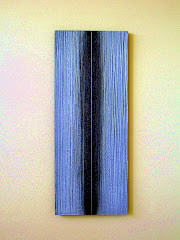
The direction my art making has taken is a good example. For the last 7 years my primary medium has been sewing thread. Previous to that I fancied myself a sculptor and installation artist, working with whatever materials the latest dumpster or thrift shop would offer. The work was surreal, psychological, dreamy. Then one day an artist friend thrust a box of industrial sewing thread spools into my arms, declaring she had no use for them but surely I would give it a try. Being an inveterate scrounger I happily took the box, despite the knowledge that the extent of my sewing experience was replacing buttons on shirts. Nonetheless I began playing with the thread, at first wrapping small object such as toys, dolls, old tools, etc. Eventually I started to get a feel for the material and took to exploring further. Much to my surprise an entirely new world opened up to my creative efforts and I expanded into wholly new and uncharted territory. 7 years later new possibilities still unfold and I find myself asking, who knew? Totally unexpected, totally wonderful.
Yet despite this mysterious unfolding and flowering in my artwork my life and psyche crashed into nothingness, a black hole out of which I barely escaped, battered and bruised and still trailing the smoke of cynicism and doubt. I was determined, but I was injured, and I was without guidance. Perhaps it was this state of mind that caused me, on that Sunday in May, to inflate a mere coincidence into something numinous and meaningful - or perhaps, just perhaps, it was the pull of creativity, of evolutionary eros. In any case, I took it as a sign and embarked on a regular practice of chakra visualizations with the Redmond CD. Over time I not only noticed the entrainment I spoke of earlier, but also a curious sensation that I could actually feel each of the chakras as I focused on them. This caught my attention as I am not usually susceptible to suggestion - I apparently can't be hypnotized, and try as I might I just cannot see, hear or touch angels and spirit guides. So this surprised me, though I didn't take it too seriously and never mentioned it to anyone.
One morning in August I was following my usual routine of Hatha Yoga exercises, ending with the Corpse Pose, flat on my back, arms at my side. I was relaxed, feeling the gentle loosening of muscles and joints and following my steady, light breathing. Suddenly and without warning an unfamiliar electric sensation rose out of nowhere at the base of my spine, grabbing my attention. At first pleasant, it seemed to slowly expand until I became alarmed at its strangeness, thinking I may have strained a muscle in my lower back. It continued to grow, and I started to panic, certain I should get up and change position. Then a thought came to me out of the blue, a voice almost, commanding me to not be a coward, to give in to the sensation. My response was quick - what have I got to lose? At that moment a huge surge of electric nerve impulse shot up my spine and into my head. My whole body convulsed as wave after wave of the most exquisite and simultaneously violent sensations shot through me. I had no clue what was happening but I allowed it to take me, and it shook me like a wet fish. For 15, 20 or more minutes I was trapped in its grip, my body flailing and writhing and convulsing on the floor, completely beyond my control even if I had wanted it - which I can assure you, I didn't. Eventually I came to exhaustion and realized it had to stop, and with that thought...it did.
I got up and walked around, bewildered and astonished. Tingling sensations continued to ripple over my skin, my head feeling as if it had expanded like a balloon. I had never in my life experienced anything remotely like this, nor anything remotely as intense. I realized a completely unknown and shockingly unexpected door had opened and I had just passed through it. As Dorothy so famously said to her companion, "Toto, I don't think we're in Kansas anymore". Indeed, everything had changed.
To be continued....
The unexpected - this is what the creative urge, the eros of becoming, always strives for. What is most astonishing is that that eros works through all of us mostly unconsciously, somehow sending us blindly down strange and unfamiliar paths that we would never choose if the opportunity was plainly handed over to our sensible selves. Yet we are pushed, or pulled, and we stumble forward not knowing if terrifying monsters or heavenly cherubs await us around the next bend.
The direction my art making has taken is a good example. For the last 7 years my primary medium has been sewing thread. Previous to that I fancied myself a sculptor and installation artist, working with whatever materials the latest dumpster or thrift shop would offer. The work was surreal, psychological, dreamy. Then one day an artist friend thrust a box of industrial sewing thread spools into my arms, declaring she had no use for them but surely I would give it a try. Being an inveterate scrounger I happily took the box, despite the knowledge that the extent of my sewing experience was replacing buttons on shirts. Nonetheless I began playing with the thread, at first wrapping small object such as toys, dolls, old tools, etc. Eventually I started to get a feel for the material and took to exploring further. Much to my surprise an entirely new world opened up to my creative efforts and I expanded into wholly new and uncharted territory. 7 years later new possibilities still unfold and I find myself asking, who knew? Totally unexpected, totally wonderful.
Yet despite this mysterious unfolding and flowering in my artwork my life and psyche crashed into nothingness, a black hole out of which I barely escaped, battered and bruised and still trailing the smoke of cynicism and doubt. I was determined, but I was injured, and I was without guidance. Perhaps it was this state of mind that caused me, on that Sunday in May, to inflate a mere coincidence into something numinous and meaningful - or perhaps, just perhaps, it was the pull of creativity, of evolutionary eros. In any case, I took it as a sign and embarked on a regular practice of chakra visualizations with the Redmond CD. Over time I not only noticed the entrainment I spoke of earlier, but also a curious sensation that I could actually feel each of the chakras as I focused on them. This caught my attention as I am not usually susceptible to suggestion - I apparently can't be hypnotized, and try as I might I just cannot see, hear or touch angels and spirit guides. So this surprised me, though I didn't take it too seriously and never mentioned it to anyone.
One morning in August I was following my usual routine of Hatha Yoga exercises, ending with the Corpse Pose, flat on my back, arms at my side. I was relaxed, feeling the gentle loosening of muscles and joints and following my steady, light breathing. Suddenly and without warning an unfamiliar electric sensation rose out of nowhere at the base of my spine, grabbing my attention. At first pleasant, it seemed to slowly expand until I became alarmed at its strangeness, thinking I may have strained a muscle in my lower back. It continued to grow, and I started to panic, certain I should get up and change position. Then a thought came to me out of the blue, a voice almost, commanding me to not be a coward, to give in to the sensation. My response was quick - what have I got to lose? At that moment a huge surge of electric nerve impulse shot up my spine and into my head. My whole body convulsed as wave after wave of the most exquisite and simultaneously violent sensations shot through me. I had no clue what was happening but I allowed it to take me, and it shook me like a wet fish. For 15, 20 or more minutes I was trapped in its grip, my body flailing and writhing and convulsing on the floor, completely beyond my control even if I had wanted it - which I can assure you, I didn't. Eventually I came to exhaustion and realized it had to stop, and with that thought...it did.
I got up and walked around, bewildered and astonished. Tingling sensations continued to ripple over my skin, my head feeling as if it had expanded like a balloon. I had never in my life experienced anything remotely like this, nor anything remotely as intense. I realized a completely unknown and shockingly unexpected door had opened and I had just passed through it. As Dorothy so famously said to her companion, "Toto, I don't think we're in Kansas anymore". Indeed, everything had changed.
To be continued....
Subscribe to:
Posts (Atom)

.jpg)