I have two clear indicators that tell me I'm touching onto the Tao of things, rising above common everyday experience and getting a glimpse of the possible, and the possibly wondrous. One is when I'm in the zone in my art making, when all of the dead ends and failures and frustrations suddenly fall away and spectacular works appear like coins under the pillow from the tooth fairy; or, as one friend put it, when one plus one starts adding up to three. The other indicator is when I start noticing synchronicities, those uncanny coincidences resonating with meaning. Frequently both indicators appear during the same day or week, at which point I start looking over my shoulder for angels and spirit guides (haven't caught any glimpses yet, alas). This is a tale of one of those periods of time.
It all began in the library. I am convinced from experience that there are library gods who nudge and guide us to books we need to read, and that the particular library gods in the Central Denver Library look favorably upon me. I like to wander the shelves on a regular basis, letting the gods have their way, prompting me towards 3 or 4 likely candidates to check out, out of which at least one will be the perfect book for that moment. In this case my eye fell upon a rather unlikely candidate, a book about making altars based on the East Indian tradition of Vastu Shastra, similar to and possibly pre-dating the Chinese tradition of Feng Shui. Feng Shui
is the more widely known knowledge of how to balance the energies of any given space to maximize mood, health and energy for those inside that space. I had been thinking about Feng Shui in relation to my art practice, and how it might be applied to promoting my work, but I'd never heard of Vastu Shastra, so it was peculiar that the book caught my attention, especially as it concerned altars.
I have a confession to make: I was raised a Catholic, and as a child I absolutely hated going to church. When I was old enough I even became an altar boy for the sole purpose of desperately trying to make the weekly torture more interesting. It didn't work (I hope my mother doesn't read this; if so...mea culpa Mom). As a result I have been one who is not favorably inclined toward altars of any kind, Catholic or otherwise, and usually prefer to imagine myself dancing naked in pagan splendor through a warm meadow - the "altar" of nature, so to speak - rather than kneeling before a table loaded with icons. But then, as Bob Dylan once said, I'm so much younger than that now. So I checked the book out. And guess what? It was really interesting.
My curiosity was piqued by the method of using the four elements - fire, water, earth and air - in relation to both the four cardinal points of the compass and to specific colors relating to the intention of the altar (the pagan in me was pleased). My apartment is perfectly oriented to the compass points, and as each direction is related to a particular intention, I had all the wall space I needed to experiment. But where was I to start? There is an Altar for Health (already healthy here), an Altar for Creativity (already creative here)...all sorts of altars. Then one caught my eye - the Altar For Attracting Helpful People and Universal Support. Heaven knows I need help, and the universe has not exactly been busting its chops in my interest lately, so I had my altar and I began to slowly assemble it. A trip to the thrift shop here, to the fabric store there, a little artwork from my studio storage, a rock from the bed of the the Platte River, and voila! I had my altar. I concocted an activation ceremony, ringing a little bell representing air, lighting a candle representing fire, rolling the river rock in my hand, dipping my fingers in a crystal bowl of water. I placed a tiny horseshoe magnet just behind an offering tray in the middle of the altar. I placed a doorway peephole in the tray, figuring the universe might want to check me out before opening the door. Then it was time to write an invocation to be placed in the offering tray - I wrote "Talk To Me!" on a plain piece of paper, placed it in front of the peephole, and the deed was done.
Little did I imagine what was to happen a few days later.
To be continued...
Thursday, May 14, 2009


Wednesday, April 29, 2009
New Exhibition
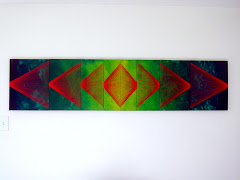
I'm opening an exhibition of my work Friday, May 1. Just finished hanging it and it looks great! It's at Namaste Hospice Art and Events Center - they have a big First Friday celebration this coming Friday, lots of food, drink, and music. Check it out!
Hour and location are as follows:
Namaste Hospice Art and Events Center
3946 Tennyson, Denver
May 1 - June 27
Thursday & Friday 12pm-5pm
Saturday 11am-3pm
Opening Reception May 1, 6-10pm
Hour and location are as follows:
Namaste Hospice Art and Events Center
3946 Tennyson, Denver
May 1 - June 27
Thursday & Friday 12pm-5pm
Saturday 11am-3pm
Opening Reception May 1, 6-10pm
Friday, April 17, 2009
Fear is a Vampire, Part II: The Cult of the Malevalent Universe
Tuning into NPR recently while driving I came upon an interview with one of the Cohn brothers, of movie making fame. He was talking of a book of poetry he had just published, and at the end of the interview William H. Macy read the title poem of the book, entitled "Drunk Drivers Have the Right of Way". It was a bleak, ugly little poem about how the brutes and power mad in life bulldoze down the rest of us and win out in the end....always, inevitably. It got me to thinking about vampires again.
What struck me about the poem was how it was less a poem then a declaration of belief, a lecture from the bully pulpit (the bully pulpit of cultural celebrity and wealth) about "reality", meant to dispel any illusions the reader might have about the truly ugly nature of life. It was...rather patronizing, in a patriarchal kind of way, like the Old Testament God with His plagues and pestilences. And like the Old Testament, it had a kind of fatalistic helplessness about it, but with a late 20th century nihilistic/existentialist/post-modern emptiness of spirit and heart.
I've only seen one of the Cohn brothers' films, "Fargo". In that film a group of brutal, brutish thugs following some blind impulse toward destruction and mayhem catalyze the darker impulses of ordinary white-bread citizens in North Dakota, leaving a long trail of blood and meaningless, stupid violence. There is a hero, the local sheriff, who prevails in the end but seems completely untouched by the events she witnesses, only sighing now and then at the tragedy of it all. It is a vision of contemporary life that presumes we are the living dead, our life-blood sucked dry, leaving us either as brutes stumbling about like the living dead in horror films, or soulless, emotionless automatons - drunk drivers and their victims. In this vision, life happens to us, and if we're lucky we get by; if not we get stomped like bugs.
I understand the cultural critique inherent in this, and I applaud the Cohn brothers for putting a mirror up to our eyes. And "Fargo" was pretty funny in a weird, deadpan kind of way, lifting some of the edge. However, after hearing the poet Cohn deliver his sermon-in-verse of hellfire and damnation it struck me that there is another agenda here. It seems many people like the poet Cohn are not content with suffering existential terror alone - they want to pull us into their black hole of despair and self-pity, as if by doing so they will somehow find a measure of redemption, or at least re-inflate their ego a little bit by proving their superior insight and sensitivity (no self-flagellation here, more like a BDSM dungeon with us as the unwilling guests).
Then it occurred to me - the poet Cohn was making a bid to become a cult leader! In general, cult leaders are narcissistic attention junkies who, like celebrities of all ilks (including art celebrities), need an audience to verify their existence to themselves. And of course, there is no shortage of people on the other end of the narcissist feed-back loop who need someone with charisma whom they can nibble upon with hungry adoration, desperate to fill their empty souls and impoverished bellys with the crumbs of personality dropped expertly from the celebrity/cult leader's plate of inflated ego. The poet Cohn's magnetism consists of his absolute certainty of the malevalence of the universe, a clever strategy since it invokes so much fear and terror in his audience, rendering them incapable of distinguishing wisdom from intellectual flabbiness, insight from blindered perception, heart and soul from mental mind games. And like many cult leaders he's a vampire, the Prince of Fear, proving once again that fear is a vampire.
What struck me about the poem was how it was less a poem then a declaration of belief, a lecture from the bully pulpit (the bully pulpit of cultural celebrity and wealth) about "reality", meant to dispel any illusions the reader might have about the truly ugly nature of life. It was...rather patronizing, in a patriarchal kind of way, like the Old Testament God with His plagues and pestilences. And like the Old Testament, it had a kind of fatalistic helplessness about it, but with a late 20th century nihilistic/existentialist/post-modern emptiness of spirit and heart.
I've only seen one of the Cohn brothers' films, "Fargo". In that film a group of brutal, brutish thugs following some blind impulse toward destruction and mayhem catalyze the darker impulses of ordinary white-bread citizens in North Dakota, leaving a long trail of blood and meaningless, stupid violence. There is a hero, the local sheriff, who prevails in the end but seems completely untouched by the events she witnesses, only sighing now and then at the tragedy of it all. It is a vision of contemporary life that presumes we are the living dead, our life-blood sucked dry, leaving us either as brutes stumbling about like the living dead in horror films, or soulless, emotionless automatons - drunk drivers and their victims. In this vision, life happens to us, and if we're lucky we get by; if not we get stomped like bugs.
I understand the cultural critique inherent in this, and I applaud the Cohn brothers for putting a mirror up to our eyes. And "Fargo" was pretty funny in a weird, deadpan kind of way, lifting some of the edge. However, after hearing the poet Cohn deliver his sermon-in-verse of hellfire and damnation it struck me that there is another agenda here. It seems many people like the poet Cohn are not content with suffering existential terror alone - they want to pull us into their black hole of despair and self-pity, as if by doing so they will somehow find a measure of redemption, or at least re-inflate their ego a little bit by proving their superior insight and sensitivity (no self-flagellation here, more like a BDSM dungeon with us as the unwilling guests).
Then it occurred to me - the poet Cohn was making a bid to become a cult leader! In general, cult leaders are narcissistic attention junkies who, like celebrities of all ilks (including art celebrities), need an audience to verify their existence to themselves. And of course, there is no shortage of people on the other end of the narcissist feed-back loop who need someone with charisma whom they can nibble upon with hungry adoration, desperate to fill their empty souls and impoverished bellys with the crumbs of personality dropped expertly from the celebrity/cult leader's plate of inflated ego. The poet Cohn's magnetism consists of his absolute certainty of the malevalence of the universe, a clever strategy since it invokes so much fear and terror in his audience, rendering them incapable of distinguishing wisdom from intellectual flabbiness, insight from blindered perception, heart and soul from mental mind games. And like many cult leaders he's a vampire, the Prince of Fear, proving once again that fear is a vampire.
Friday, April 3, 2009
Fear is a Vampire
I attended an informal talk with two art critics recently. The room was packed with energetic, forward-looking artists, eager to absorb useful information and insights from the arbiters of culture employed by our local newspapers. The moderator asked them to comment on their view of the local art scene, the trends and potentials. The first one to speak on the subject opened up the conversation with this line - "As we sit here on the cusp of the next Great Depression, completely paralyzed,....", and he went on from there in a low-key, almost bleak tone of voice; it felt like he was going to stop at any moment and take a deep sigh, maybe melt into a puddle of dark, black despair in front of our eyes. As you might imagine, the energy in the room immediately began a slow fizzle, the audience's shoulders drooping, eyes furrowing. I felt like shouting out "Speak for yourself!", but kept my mouth politely zippered (in retrospect, I wish I had spoken up).
In thinking about his comment on the way home it occurred to me that practically every meaningful discussion these days is prefaced by a reminder that the economy is bad, as if none of us is aware despite endless news reports and headlines warning of impending doom. I thought this might make a good Saturday Night live skit. Imagine a room full of people at a cocktail party sipping drinks and chatting, the conversation going something like this:
John: Well Glenda, since the economy is tanking, can I get you a drink?
Glenda: Yes John, I'd like a red wine in light of the highest unemployment rate in 25 years.
John: Being on the cusp of the next Great Depression, I bet you'd love a good Cabernet. I'm paralyzed myself, but before I go to the bar, let me introduce you to my good friend Hilda. (takes Glenda by the arm and steers her to a woman just entering the room) Hilda, so good to see you! Have you heard that 5.3 million jobs have been lost since September? Let me introduce you to my friend Glenda.
Hilda: Well John, given that we're in the middle of the worst recession in 30 years, I'd love to meet your friend!
Ok, SNL would do it better, but you get my gist. Musing on this brought my mind to a book I read a while back, "Toward a Psychology of Being" by Abraham Maslow. A psychologist born in 1908, Maslow came of age during the Great Depression and the slaughters of WWII, and his studies were steeped in the pessimism of Freud and the Existentialists. Curiously, his writings managed to turn Freud inside out, and his philosophy developed quite differently.
Maslow took a look at motivation, and made some interesting observations. He identified one type of motivation, the predominant one in our culture and age, as deficiency motivation. This is a motivation based on lack, on the desire to fill an empty hole, so to speak. Primary biological needs come under this category - hunger, thirst, shelter, etc. - but also a need for love, for attention because of lack of self-esteem, for prestige, for fame, for a new shiny car, for all of those things we don't have but want want want. In other words, neediness. Most people are driven primarily by these motivations. But he also took a focused look at a type of person he found intriguing, what he called the self-actualized person. These people have deficiency motivations, but their primary motivations are what he called growth motivations. These motivations are for creativity, exploration, learning, loving (versus wanting love), expansion, etc. He found this was a group who were more joyful, more giving, more ambitious, more curious, whatever the circumstance they found themselves in. He also found that these people were superior problem solvers, theorizing that those dominated by deficiency motivation saw various aspects of reality in light of whether or not it satisfied deficiencies, while the self-actualized had a more complete picture of reality, saw situations more clearly for what they were rather than for what they might be useful for, and therefore were able to make better choices and decisions. While Freud focused on the unhealthy - the neurotic and the psychotic - in order to learn how to cope, Maslow chose to focus on the healthy - the self-actualized - in order to learn how to live fully.
Motivation built on fear is a deficiency motivation. It clouds our thinking, confuses us, "paralyzes" us. I have a friend who spends most evenings on the Internet researching theories and opinions about the current world economic crisis. Every time I see him it's all he can talk about, and he's worked himself into a frenzy of paranoia and misery, an out of control feedback loop. He has chosen this, of course - deficiency motivation can cause us to make bad choices. He's a bit like the art critic I spoke of, not only afraid but insistent on making sure everyone else views reality from a vantage point of fear (misery loves company). They both drain energy from others, sucking it into a vortex of their own imaginings. They are cowards, afraid to live while simultaneously cringing at that fear of all fears, the fear of death.
Fear is a vampire - it sucks your lifeblood and turns you into a zombie, the living dead.
In thinking about his comment on the way home it occurred to me that practically every meaningful discussion these days is prefaced by a reminder that the economy is bad, as if none of us is aware despite endless news reports and headlines warning of impending doom. I thought this might make a good Saturday Night live skit. Imagine a room full of people at a cocktail party sipping drinks and chatting, the conversation going something like this:
John: Well Glenda, since the economy is tanking, can I get you a drink?
Glenda: Yes John, I'd like a red wine in light of the highest unemployment rate in 25 years.
John: Being on the cusp of the next Great Depression, I bet you'd love a good Cabernet. I'm paralyzed myself, but before I go to the bar, let me introduce you to my good friend Hilda. (takes Glenda by the arm and steers her to a woman just entering the room) Hilda, so good to see you! Have you heard that 5.3 million jobs have been lost since September? Let me introduce you to my friend Glenda.
Hilda: Well John, given that we're in the middle of the worst recession in 30 years, I'd love to meet your friend!
Ok, SNL would do it better, but you get my gist. Musing on this brought my mind to a book I read a while back, "Toward a Psychology of Being" by Abraham Maslow. A psychologist born in 1908, Maslow came of age during the Great Depression and the slaughters of WWII, and his studies were steeped in the pessimism of Freud and the Existentialists. Curiously, his writings managed to turn Freud inside out, and his philosophy developed quite differently.
Maslow took a look at motivation, and made some interesting observations. He identified one type of motivation, the predominant one in our culture and age, as deficiency motivation. This is a motivation based on lack, on the desire to fill an empty hole, so to speak. Primary biological needs come under this category - hunger, thirst, shelter, etc. - but also a need for love, for attention because of lack of self-esteem, for prestige, for fame, for a new shiny car, for all of those things we don't have but want want want. In other words, neediness. Most people are driven primarily by these motivations. But he also took a focused look at a type of person he found intriguing, what he called the self-actualized person. These people have deficiency motivations, but their primary motivations are what he called growth motivations. These motivations are for creativity, exploration, learning, loving (versus wanting love), expansion, etc. He found this was a group who were more joyful, more giving, more ambitious, more curious, whatever the circumstance they found themselves in. He also found that these people were superior problem solvers, theorizing that those dominated by deficiency motivation saw various aspects of reality in light of whether or not it satisfied deficiencies, while the self-actualized had a more complete picture of reality, saw situations more clearly for what they were rather than for what they might be useful for, and therefore were able to make better choices and decisions. While Freud focused on the unhealthy - the neurotic and the psychotic - in order to learn how to cope, Maslow chose to focus on the healthy - the self-actualized - in order to learn how to live fully.
Motivation built on fear is a deficiency motivation. It clouds our thinking, confuses us, "paralyzes" us. I have a friend who spends most evenings on the Internet researching theories and opinions about the current world economic crisis. Every time I see him it's all he can talk about, and he's worked himself into a frenzy of paranoia and misery, an out of control feedback loop. He has chosen this, of course - deficiency motivation can cause us to make bad choices. He's a bit like the art critic I spoke of, not only afraid but insistent on making sure everyone else views reality from a vantage point of fear (misery loves company). They both drain energy from others, sucking it into a vortex of their own imaginings. They are cowards, afraid to live while simultaneously cringing at that fear of all fears, the fear of death.
Fear is a vampire - it sucks your lifeblood and turns you into a zombie, the living dead.
Thursday, March 26, 2009
The Tao of Art Making: Part I - Feedback Loops
I was speaking recently with an artist friend about the difficulty she was having climbing out of a creative rut. She was blocked, had not painted for weeks and couldn't get off the dime. This is a perennial problem for most artists of all types - cycles of creative fever and action followed by the sudden disappearance of passion and joy, the muse silent, the divine spark quenched. I call it an art hangover, and like an alcohol hangover it makes us feel lousy. There is no simple hair-of-the-dog cure for an art hangover, but there are tricks and techniques that, if employed with diligence and discipline, can go a long way toward mitigating the depth of the crash into the creative black hole, and smoothing the road of return. In other words, there is The Practice. And, as the term implies, it takes practice. Regular practice. Disciplined practice. Persevering practice. Faithful practice.
It also takes an understanding of how the creative process works. Every one of us has to dig deep to find the individual blueprint of that process, but there are common landmarks within that sometimes mysterious, sometimes murky terrain of the inner self that can be shared. There are maps that can be consulted. There are compasses that always point to true north. There are doorways that can be opened with a skeleton key. I call it The Tao of Art Making. And yes, hitchhiking is permitted, even encouraged.
The art making process can be considered on one level as a system - the artist's intent interacting with the raw materiality of the world to create a painting, a dance, a book, a symphony. An idea cannot just sit in the head, it has to emerge into materiality, and it needs a system to accomplish that, a system that is flexible and evolves. This is where feedback loops come in, a fundamental concept of Systems theory. In a feedback loop you have output, input, a comparer, and a regulator. Input is the goal, output is the result, the comparer tests the goal with the result, the regulator adjusts to meet that goal. The thermostat in your home is a particular kind of feedback loop, a negative feedback loop. The goal is the desired temperature of the room, the result is the actual temperature, the comparer is the thermometer, and the regulator is the switch that is controlled by the thermometer, turning the heat on or off. This is called a negative feedback loop because when the system is out of equilibrium (too hot or too cold) the regulator tries to bring it back to stability, reducing the difference between input and output. A positive feedback loop adds to the difference between input and output - the most obvious example being a microphone and speaker getting too close to each other, the mic picking up sound from the speaker, adding it to the speaker, which it then picks ups and adds again, and so on until a loud screeching overload is heard and everyone covers their ears, screaming "Turn off the feedback!!!!".
Now, back to my artist friend. She's stuck in a negative feedback loop - the system is stable, but it's producing nothing new. Art making goes in cycles, just like most of the rest of life, and a stable system can be a good thing. It allows one to step back, take a deep breath, recuperate and evaluate with a sober eye and mind. But my friend is stuck, and the negative feedback loop has gone from stable to pathologically depressing (ok, that's a bit melodramatic - she has a touch of the blues). She wants to be in a positive feedback loop, but she doesn't want to become a screeching microphone either. It looks like the choice is between two pathologies; this is a dilemma. However, there is a third option - the morphogenic positive feedback loop. This is a positive feedback loop that PRODUCES CHANGES IN THE SYSTEM! In other words, it's a self-evolving feedback loop. As an artist, or in any walk of life I would hope, that's what the search is for.
Let me give some examples. I read long ago about a writer who published a wildly successful first novel, gaining fame and wealth and a retainer from his publishing company to complete a second work. He never did. He got caught in a demonic negative feedback loop, and suffered permanent writer's block. Five years later he committed suicide in despair. At the other end of the spectrum is Vincent Van Gogh, a story we all know well. He got caught up in a pathological positive feedback loop, spinning further and further out of control (aided by a doctor who was prescribing poisons to cure him), producing great works that sadly chronicled his increasing dementia, until he ended the torture by also taking his life. Here are examples of the two extremes of pathological feedback loops. Then there is the story of Emanuel Swedenborg, a man I wrote about in a previous blog. A brilliant Age of Enlightenment scientist, Swedenborg suddenly, at the age of 56, began having conversations with angels. He spent the rest of his life until the age of 84 writing about what they had to say. Happily. Smiled alot. Was a great dinner companion, generous and gregarious. He had found a morphogenic positive feedback loop, and took the ride of his life.
This all begs an important question: How does my friend get out of her rut, her slightly pathological negative feedback loop? There are many temporary fixes, but in the long run she needs...The Practice.
To be continued...
It also takes an understanding of how the creative process works. Every one of us has to dig deep to find the individual blueprint of that process, but there are common landmarks within that sometimes mysterious, sometimes murky terrain of the inner self that can be shared. There are maps that can be consulted. There are compasses that always point to true north. There are doorways that can be opened with a skeleton key. I call it The Tao of Art Making. And yes, hitchhiking is permitted, even encouraged.
The art making process can be considered on one level as a system - the artist's intent interacting with the raw materiality of the world to create a painting, a dance, a book, a symphony. An idea cannot just sit in the head, it has to emerge into materiality, and it needs a system to accomplish that, a system that is flexible and evolves. This is where feedback loops come in, a fundamental concept of Systems theory. In a feedback loop you have output, input, a comparer, and a regulator. Input is the goal, output is the result, the comparer tests the goal with the result, the regulator adjusts to meet that goal. The thermostat in your home is a particular kind of feedback loop, a negative feedback loop. The goal is the desired temperature of the room, the result is the actual temperature, the comparer is the thermometer, and the regulator is the switch that is controlled by the thermometer, turning the heat on or off. This is called a negative feedback loop because when the system is out of equilibrium (too hot or too cold) the regulator tries to bring it back to stability, reducing the difference between input and output. A positive feedback loop adds to the difference between input and output - the most obvious example being a microphone and speaker getting too close to each other, the mic picking up sound from the speaker, adding it to the speaker, which it then picks ups and adds again, and so on until a loud screeching overload is heard and everyone covers their ears, screaming "Turn off the feedback!!!!".
Now, back to my artist friend. She's stuck in a negative feedback loop - the system is stable, but it's producing nothing new. Art making goes in cycles, just like most of the rest of life, and a stable system can be a good thing. It allows one to step back, take a deep breath, recuperate and evaluate with a sober eye and mind. But my friend is stuck, and the negative feedback loop has gone from stable to pathologically depressing (ok, that's a bit melodramatic - she has a touch of the blues). She wants to be in a positive feedback loop, but she doesn't want to become a screeching microphone either. It looks like the choice is between two pathologies; this is a dilemma. However, there is a third option - the morphogenic positive feedback loop. This is a positive feedback loop that PRODUCES CHANGES IN THE SYSTEM! In other words, it's a self-evolving feedback loop. As an artist, or in any walk of life I would hope, that's what the search is for.
Let me give some examples. I read long ago about a writer who published a wildly successful first novel, gaining fame and wealth and a retainer from his publishing company to complete a second work. He never did. He got caught in a demonic negative feedback loop, and suffered permanent writer's block. Five years later he committed suicide in despair. At the other end of the spectrum is Vincent Van Gogh, a story we all know well. He got caught up in a pathological positive feedback loop, spinning further and further out of control (aided by a doctor who was prescribing poisons to cure him), producing great works that sadly chronicled his increasing dementia, until he ended the torture by also taking his life. Here are examples of the two extremes of pathological feedback loops. Then there is the story of Emanuel Swedenborg, a man I wrote about in a previous blog. A brilliant Age of Enlightenment scientist, Swedenborg suddenly, at the age of 56, began having conversations with angels. He spent the rest of his life until the age of 84 writing about what they had to say. Happily. Smiled alot. Was a great dinner companion, generous and gregarious. He had found a morphogenic positive feedback loop, and took the ride of his life.
This all begs an important question: How does my friend get out of her rut, her slightly pathological negative feedback loop? There are many temporary fixes, but in the long run she needs...The Practice.
To be continued...
Subscribe to:
Posts (Atom)

.jpg)